
Everything about indoor cannabis growing – from grow room setup, lighting, ventilation, substrates and nutrients to the vegetative phase, flowering, harvest timing, and the most common mistakes.
Indoor cannabis growing offers maximum control over all environmental factors and enables year-round harvests regardless of weather and season. In a Cannabis Social Club under the KCanG (German Cannabis Act), communal growing in enclosed spaces is the standard cultivation method. This guide covers all essential aspects – from grow room planning to harvest.
## Grow Room Setup: The Foundation of Successful Growing
Before a single plant is placed, the growing space must be carefully planned. The key factors are: sufficient space, access to electricity and water, provision for intake and exhaust ventilation, and light-tightness during the dark period.
A typical grow room for personal supply or a small Cannabis Social Club covers an area of 1.2 m × 1.2 m to 3 m × 3 m. Ceiling height should be at least 2 m to allow adequate distance between lights and the plant canopy. Grow tents made of reflective Mylar material are a cost-effective solution for smaller setups – they reflect up to 95% of light back onto the plants and are easy to assemble.
Interior walls should be lined with reflective material. Flat white paint reflects about 85–90% of light and is an affordable alternative to Mylar. Aluminium foil is not recommended as it can create hot spots. The floor should be waterproof and easy to clean – pond liner or PVC flooring works well. A slight slope towards a drain prevents standing water.
Electricity is the largest ongoing cost factor. A typical 1.2 m × 1.2 m growing area with LED lighting consumes approximately 400–600 watts for illumination plus another 100–200 watts for ventilation and peripherals. At 18 hours of light per day during the vegetative phase, this results in monthly consumption of 250–450 kWh. Electrical installations must be professionally executed – moisture and electricity require RCD protection and splash-proof outlets.
## Lighting: LED, HPS, and CMH Compared
Light is the most important growth factor in indoor cultivation. The three most common lighting technologies are LED (Light Emitting Diode), HPS (High Pressure Sodium), and CMH (Ceramic Metal Halide).
**LED (Light Emitting Diode):** LEDs have established themselves as the standard in both professional and hobby cannabis growing. Modern full-spectrum LEDs offer a broad light spectrum covering all growth phases. Advantages: highest energy efficiency (up to 3.0 µmol/J), low heat output, long lifespan (50,000+ hours), dimmable and programmable, different spectra for veg and bloom possible. Disadvantages: higher initial cost, cheap LEDs may provide inferior spectrum. Recommended PPFD values: 400–600 µmol/m²/s in vegetative phase, 800–1000 µmol/m²/s in flower. Samsung LM301B and LM301H diodes are considered industry standard.
**HPS (High Pressure Sodium):** HPS lamps were the gold standard for decades. They offer a yellow-orange light spectrum particularly suited to the flowering phase. Advantages: proven technology, lower purchase cost, good canopy penetration. Disadvantages: high heat output (requires stronger cooling), lower energy efficiency (1.0–1.7 µmol/J), shorter bulb lifespan (12,000–24,000 hours), not dimmable. A 600W HPS suits 1.2 m × 1.2 m, a 1000W HPS suits 1.5 m × 1.5 m.
**CMH (Ceramic Metal Halide):** CMH lamps offer a broader and more natural light spectrum than HPS with better efficiency. Advantages: good full spectrum, better terpene development according to many growers, moderate efficiency (1.5–2.0 µmol/J). Disadvantages: higher purchase cost than HPS, UV radiation requires protective eyewear. 315W CMH lamps are the standard size, suitable for 1 m × 1 m to 1.2 m × 1.2 m.
**Recommendation:** For beginners and Cannabis Social Clubs, full-spectrum LEDs are the best choice, offering the lowest operating costs, least heat output, and greatest flexibility.
## Light Cycles: Photoperiod Controls Growth
Cannabis is a photoperiodic plant – meaning flowering is triggered by day length (exception: autoflowering varieties).
**Vegetative Phase:** 18 hours light / 6 hours darkness (18/6). Some growers use 20/4 or even 24/0, but 18/6 offers the best balance between growth and energy costs. The dark period allows the plant to convert starch to sugar and direct energy towards root growth.
**Flowering Phase:** 12 hours light / 12 hours uninterrupted darkness (12/12). Switching to 12/12 simulates shortening autumn days and triggers flower formation. It is absolutely critical that the 12-hour dark period is not interrupted by any light – even brief flashes can disrupt flowering or induce hermaphroditism.
**Autoflowering Varieties:** These begin flowering automatically after a genetically predetermined period (usually 2–4 weeks after germination), regardless of light cycle. They are typically grown under 18/6 or 20/4 throughout their entire life cycle.
## Ventilation: Fresh Air, CO₂, and Odour Control
A well-designed ventilation system is essential for healthy plant growth. It serves multiple functions: supplying fresh CO₂, removing heat and humidity, strengthening stems through air movement, and controlling odour.
The basic rule: the entire air volume of the grow room should be exchanged at least once per minute. For a room with 3 m³ volume, an exhaust fan with at least 180 m³/h capacity is needed. Carbon filters on the exhaust system effectively neutralise the characteristic odour – they should be replaced every 12–18 months.
Intake air should be supplied from below or at mid-height; exhaust is extracted from above (warm, humid air rises). Fans inside the room ensure even air movement and prevent microclimate zones with high humidity that promote mould growth. Stems swaying gently in the breeze promotes stem strength – an effect known as thigmomorphogenesis.
**CO₂ Supplementation:** Under normal conditions, air contains about 400 ppm CO₂. Cannabis can grow faster and yield more at elevated CO₂ levels (800–1500 ppm) – but only when all other factors (light, nutrients, temperature) are also optimal. CO₂ supplementation is mainly worthwhile for advanced growers with strong lighting (PPFD > 1000 µmol/m²/s).
## Temperature and Humidity: The Perfect Climate
Cannabis thrives within a relatively narrow climate window. Deviations can slow growth, cause stress, and encourage pests or diseases.
**Optimal Temperatures:** Vegetative phase: 22–28°C (light period), 18–22°C (dark period). Flowering phase: 20–26°C (light period), 16–20°C (dark period). In the last two weeks before harvest, a slight temperature drop during the dark period (15–18°C) can promote anthocyanin formation, leading to purple coloration. Temperatures above 30°C slow growth and can destroy terpenes. Temperatures below 15°C drastically slow growth and can cause cold stress.
**Optimal Humidity (Relative Humidity – RH):** Seedling/clone: 65–70% RH. Vegetative phase: 40–60% RH. Early flower: 40–50% RH. Late flower: 30–40% RH. Low humidity in late flower is critical to prevent Botrytis (grey mould), which can attack dense buds and destroy the entire harvest.
**VPD (Vapor Pressure Deficit):** Advanced growers use VPD values, which describe the relationship between temperature and humidity regarding plant transpiration. Optimal VPD values are 0.8–1.2 kPa in the vegetative phase and 1.0–1.5 kPa in flower.
## Substrates: Soil, Coco, and Hydroponics
The substrate is the medium in which roots grow. Each substrate has its own advantages and disadvantages.
**Soil:** The most natural and forgiving substrate. High-quality pre-fertilised cannabis soil contains nutrients for 3–6 weeks. Soil buffers pH fluctuations better than other substrates. Advantages: easiest handling, natural terpene profile, organic growing possible, forgiving of errors. Disadvantages: slower growth than hydro, harder to monitor, can harbour pests. Optimal pH: 6.0–6.5.
**Coco Coir:** Coco is an inert substrate made from coconut husks. It combines the ease of soil with the faster growth rates of hydroponic systems. However, coco must be irrigated with nutrient solution from the start. Advantages: excellent air-water ratio, faster growth than soil, reusable, good for drain-to-waste systems. Disadvantages: requires regular nutrient feeding, no natural nutrient content, can promote calcium deficiency (coco binds calcium). Optimal pH: 5.5–6.5. Coco must be washed and pre-treated with calcium-magnesium before use.
**Hydroponics:** In hydroponic systems, roots grow directly in nutrient solution or in inert media such as expanded clay (LECA), rockwool, or perlite, which are regularly flushed with nutrient solution. Common systems: DWC (Deep Water Culture), NFT (Nutrient Film Technique), Ebb & Flow, Drip Systems. Advantages: fastest growth and highest yields, precise nutrient control, clean environment. Disadvantages: highest initial investment, least forgiving of errors, pump failure can kill plants quickly, requires daily pH and EC monitoring. Optimal pH: 5.5–6.0.
## Nutrient Management: NPK and Micronutrients
Cannabis, like all plants, requires macro- and micronutrients. The three primary nutrients are nitrogen (N), phosphorus (P), and potassium (K) – listed as the NPK ratio on fertiliser bottles.
**Vegetative Phase:** Higher nitrogen demand for leaf and stem growth. Typical NPK ratio: 3-1-2 or 2-1-2. Nitrogen is crucial for chlorophyll production and vegetative growth.
**Flowering Phase:** Lower nitrogen, higher phosphorus and potassium demand. Typical NPK ratio: 1-3-2 or 0-3-3. Phosphorus promotes flower formation; potassium supports metabolism and resin production.
**Micronutrients:** Calcium, magnesium, sulphur, iron, manganese, zinc, copper, boron, and molybdenum are also essential in smaller quantities. Calcium and magnesium are particularly important when using coco or reverse osmosis water – a cal-mag supplement is often necessary.
**Over-fertilisation vs. Under-fertilisation:** The most common beginner mistake is over-fertilisation. Nutrient burn appears as brown, crispy leaf tips. The rule is: less is more. Better to start at 50% of the manufacturer's recommended dose and slowly increase.
## pH and EC: The Invisible Key Factors
**pH Value:** The pH determines which nutrients the plant can absorb. At incorrect pH, certain nutrients are locked out – even if present in the solution. This is called Nutrient Lockout and is one of the most common causes of deficiency symptoms. In soil: pH 6.0–6.5. In coco/hydro: pH 5.5–6.0. pH should be measured and adjusted with every watering. pH-Up (potassium hydroxide) and pH-Down (phosphoric acid) are the standard correction agents.
**EC Value (Electrical Conductivity):** EC measures the total concentration of dissolved salts in the nutrient solution, indicating solution strength. Recommended EC values: seedlings 0.4–0.6 mS/cm, vegetative phase 0.8–1.4 mS/cm, early flower 1.2–1.8 mS/cm, late flower 1.5–2.0 mS/cm. Runoff EC should not exceed 0.3–0.5 mS/cm above input value – otherwise salts accumulate in the substrate.
## Vegetative Phase: Maximising Growth
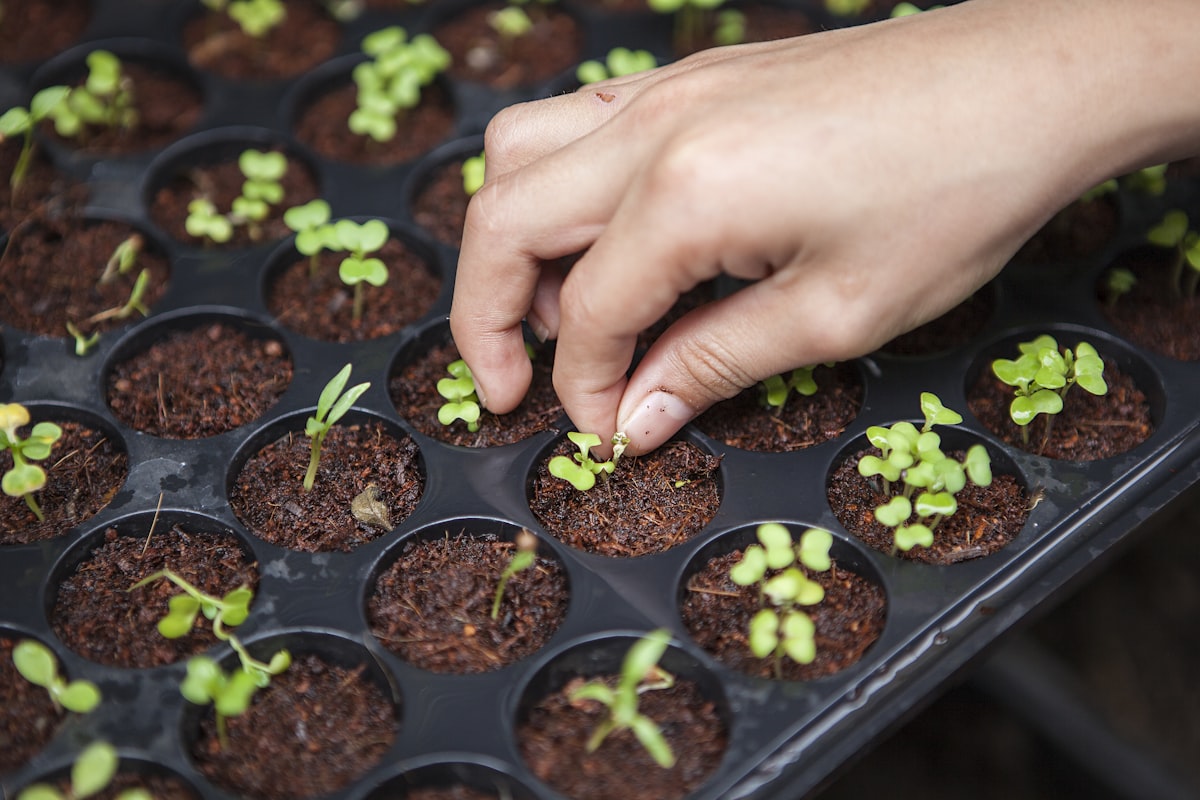
The vegetative phase begins when the seedling develops its first true leaf pair and typically lasts 4–8 weeks (depending on desired plant size). During this phase, the plant focuses on root, stem, and leaf development.
**Training Techniques:** LST (Low Stress Training) gently bends shoots downward and to the sides to create an even canopy. Topping cuts the main shoot above the fourth or fifth node, causing two new main shoots to form. FIMming (Fuck, I Missed) removes approximately 75% of the shoot tip, often producing four new shoots. SCROG (Screen of Green) uses a net at a set height through which shoots are woven – creating a flat, even canopy that maximises light utilisation.
**Transplanting:** Seedlings start in small pots (0.5–1 L) and are moved to larger containers once roots have colonised the available space. Typical final size: 11–20 L. Air pots and fabric pots promote root growth through air pruning – root tips are killed at the pot wall through air contact, encouraging the formation of fine lateral roots.
## Flowering Phase: Bud Development and Maturation
The flowering phase is initiated by switching to the 12/12 light cycle and lasts 7–12 weeks depending on strain (indica-dominant strains typically 7–9 weeks, sativa-dominant 10–14 weeks).
**Stretch Phase (Week 1–3):** After switching to 12/12, plants often stretch another 50–100% of their height – the so-called flowering stretch. During this phase, the first flower sites (preflowers) form and sex becomes visible. Male plants or hermaphrodites must be removed immediately to prevent pollination.
**Bud Formation (Week 3–6):** Buds grow and densify. Trichome production begins – the small mushroom-shaped glands that produce cannabinoids and terpenes. Nutrient demand peaks during this phase. Regular defoliation can improve light penetration and air circulation but should be done carefully to avoid stressing the plant.
**Maturation (Week 6 to Harvest):** Buds ripen and develop full potency. Many growers perform a flush in the final 1–2 weeks – watering with pH-adjusted water only, no nutrients, to wash remaining salts from the substrate. Whether flushing actually improves flavour is scientifically debated but widely practised among growers.
## Determining Harvest Time
The correct harvest time is crucial for potency and effect profile. The most important method is trichome observation using a loupe or digital microscope (60–100x magnification).
**Clear Trichomes:** Trichome heads are glassy and transparent. The plant is not yet ripe – THC content is suboptimal.
**Milky/Cloudy Trichomes:** Trichome heads are milky white and opaque. This indicates maximum THC content. Harvesting at 80–90% milky trichomes yields a more activating, cerebral high.
**Amber Trichomes:** THC is degrading to CBN (cannabinol). CBN has sedative properties. Harvesting at 20–30% amber and 70–80% milky trichomes yields a more body-focused, relaxing result.
Additional ripeness indicators: pistils (hairs) on the buds change from white to orange-brown. When 60–70% of pistils have changed colour, the plant is approaching ripeness. Leaves begin to yellow – a natural process during maturation.
## Common Mistakes in Indoor Growing
**Overwatering:** The most common beginner mistake. Cannabis needs wet-dry cycles – the top 2–3 cm of substrate should dry out before watering again. Overwatering leads to oxygen deprivation at the roots, causing root rot and slow growth. Rule of thumb: better to water thoroughly once and wait than give small amounts daily.
**Over-fertilisation:** Nutrient burn is recognisable by brown, crispy leaf tips curling upward. Immediate action: flush with pH-adjusted water (three times pot volume), then continue with reduced nutrient dose.
**Incorrect pH:** Causes nutrient lockout – the plant shows deficiency symptoms despite adequate fertilisation. Calibrate pH meter regularly and measure pH with every watering.
**Light Burn:** Insufficient distance between lamp and plant tops causes bleached, white leaf tips. LED manufacturers specify recommended distances – follow these and verify with a PAR meter if possible.
**Inadequate Ventilation:** Leads to mould, mildew, and weak stems. Air movement must be noticeable but not so strong that leaves flap wildly.
**Lack of Pest Prevention:** Fungus gnats, spider mites, thrips, and aphids can multiply explosively in indoor environments. Preventive measures: yellow sticky traps, neem oil treatments, introduction of beneficial insects such as predatory mites. Regularly inspect leaf undersides with a magnifying glass.
**Impatience at Harvest:** Harvesting too early wastes potency and yield. The last two weeks are critical for trichome maturation. Always check with a loupe – never harvest by calendar alone.
Related Articles
Organic Cannabis Growing: Living Soil and Natural Methods
Everything about organic cannabis growing – living soil, compost teas, mycorrhizae, worm castings, natural pest control, companion planting, super soil recipes, and the no-till method for optimal terpene profiles.
After Harvest: Drying, Curing, and Storage
The complete guide from harvest to finished product – harvest timing, wet trim vs. dry trim, optimal drying conditions, jar curing, burping technique, cure duration, long-term storage, and common mistakes.